7 Strategies for Encouraging AI Skills Building in the Classroom: Tips for Educators
May 05 , 2026
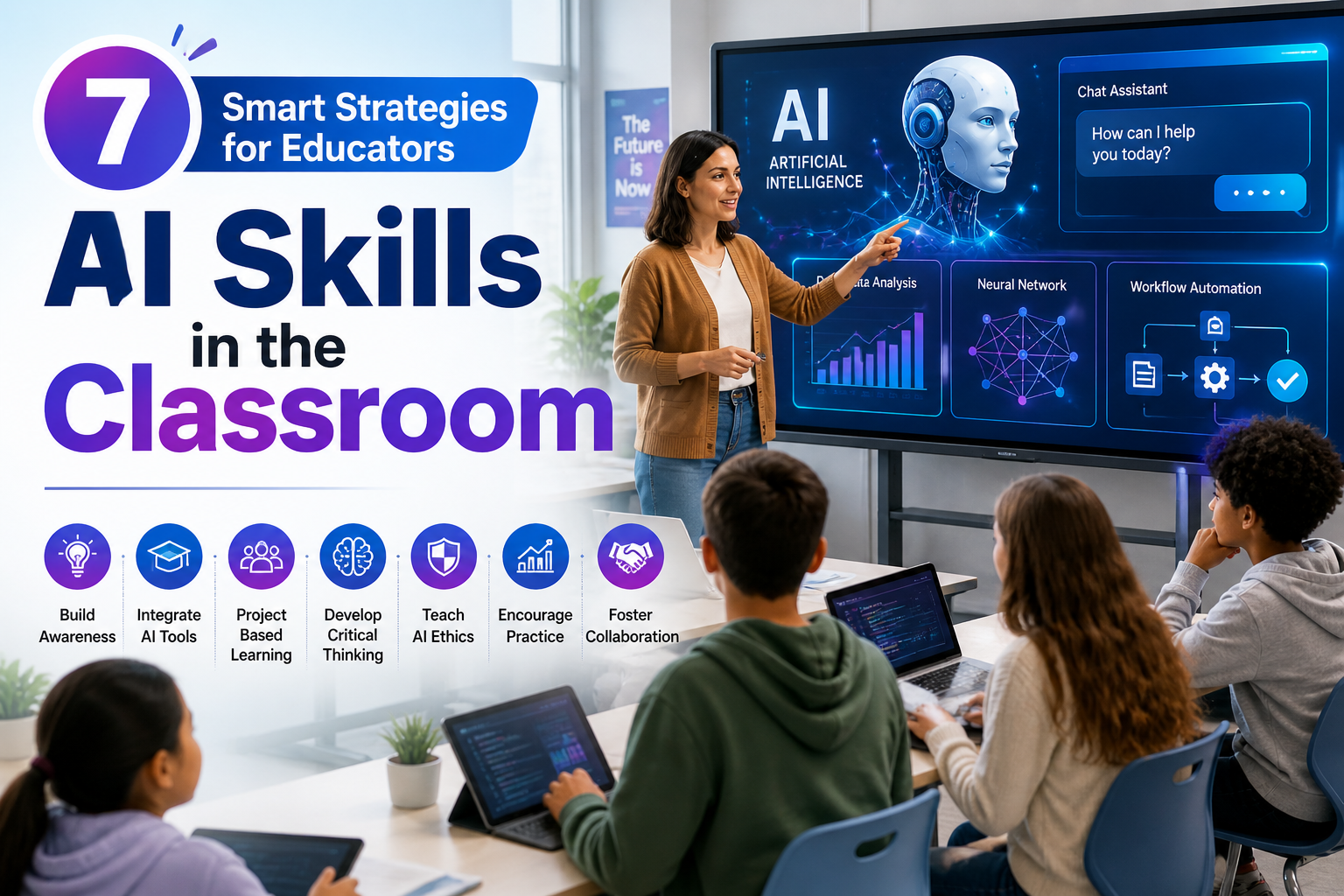
India has been a fierce adopter of AI and emerging technologies globally, and these technology trends are being reflected in our education system as well.
Across Tier 2 and 3 cities, AI skills-building components are being integrated in classrooms faster than most lesson plans can keep up with. One minute, students were hearing about it online, and the next they were using it to brainstorm, generate ideas, or create visuals with an AI art generator. Whether it’s encouraged or not, students are already experimenting with these tools in their own time.
But what role do India’s educators play when it comes to cultivating AI-readiness in our next generation? The value of AI adoption in classroom activities lies in helping students figure out how to approach using AI through an appropriate lens (i.e. to boost their dynamic output rather than to simply outsource their work).
A lot of the theories surrounding AI education are really quite simple, but building familiarity with them can help educators to build those skills into the classroom without overcomplicating things for students at all learning levels.
Start With Prompt Writing, Not Just Outputs
Before students start generating images or answers, it helps to slow things down and focus on how they’re asking for things in the first place.
Learning how to write AI art prompts can be a surprisingly effective gateway. It trains them to be more specific, descriptive, and intentional. Rather than typing "make a cat", they learn to think in detail – style, lighting, environment, mood. The same thinking applies to writing, research, and even problem-solving.
It also makes it pretty clear early on that the quality of what comes out is a direct reflection of the quality of what you put in. AI isn’t just “doing the work”. Students still need to think carefully about what they want and how to communicate it.
Demonstrate What Good and Bad Use Looks Like
The majority of students aren't intentionally abusing AI, and it’s important to keep this in mind. Most simply don’t have any idea of what constitutes “good use.” And it also doesn’t land when we tell students “AI isn’t perfect.” Showing them usually does.
It's relatively easy to demonstrate the drawbacks and limitations of AI. Firstly, generate a poor-quality paper created using AI chatbots entirely. Then, show them the revised version. Ask them to point out differences in quality. Perhaps it's too vague, maybe it sounds confident but isn’t quite right, maybe it just uses the typical AI filler words. Whatever the case, it's an easy way of demonstrating how outputs are not perfect.
You can even engage students in this process. This allows them to discover first-hand that AI isn't inherently bad or good. Instead, it's the application and extent of refinement that determines usefulness.
Get Students to Reflect Over Their AI Usage
If students are using AI, you need to understand why and how. This doesn’t have to be complicated. Some of the best questions are the simplest ones: What tools did you use to complete this particular task, and why? What prompt did you give the tool in order to achieve this output? What changes did you make to the output? What didn’t work as expected?
This does two things. One, it creates some transparency around what students are doing. Two, it differentiates authentic engagement vs simple copy-paste behaviour. It also makes it easier to explain why accuracy, clarity, and judgement still matter. Because in the real world, getting it wrong has real consequences.
Build Critical Thinking Into AI Use
AI misses the mark occasionally, and that is a lesson in itself. This is exactly why students should be encouraged to question outputs, instead of accepting them as gospel. It’s important to get them to verify facts, cross-check answers, or see where the pieces don’t fit together. Critical thinking is the name of the game.
You can also turn this into an activity by pointing out the weaknesses and drawbacks of AI. It doesn’t take much. Ask it something slightly ambiguous or outside its strengths. The output is likely to be somewhat inaccurate. This is the perfect opportunity to discuss these issues.
Once students see firsthand how AI can generate persuasive information that may not be 100% accurate, they’re much less likely to take everything it churns out at face value.
Show Where AI Fits in Real Workplaces
Students are much more likely to connect with something if they understand its relevance beyond academia. Rather than treating AI as an abstract concept, it helps to demonstrate how AI is already a part of almost every job in the real world.
Whether it’s content teams putting together drafts for marketing campaigns, businesses analysing trends and sales patterns, or customer service teams using chatbots and tools to answer basic FAQs – AI just has been made part of the job across almost every space today. These aren’t niche examples anymore. They’re being integrated into regular workflows in many different industries.
Things tend to click a little faster when students can relate what they’re learning to real tasks people are doing at work, it clicks a bit faster. It stops feeling like a novelty and starts to feel like a skill they’ll actually need.
Set Clear Boundaries Without Killing Creativity
Rather than banning them from using ChatGPT or any other AI tool, a better approach is often just being specific about where it fits in. Students are often more receptive if clear expectations are communicated up front.
For example, you might allow them to use it only in preliminary phases, such as brainstorming or organising their ideas. Maybe you allow it for visuals, but not written responses. Whatever the case, making it crystal clear that the final product must be entirely their own is incredibly important.
Guidelines clarify the grey areas and support students in understanding why the tool is being used, rather than providing an excuse to misuse it.
Stay Curious Alongside Your Students
Teachers don’t need to have all the answers when it comes to AI. Realistically speaking, it’s something that has only become mainstream in the last few years and the reality is that many teachers are still learning alongside their students. And that’s totally fine.
In fact, approaching it with curiosity can create more of an open learning environment. By testing tools together and transparently discussing what’s working, what isn’t, and why, you create a more collaborative experience.
Students are always experimenting. That curiosity becomes far more valuable when it’s guided instead of snuffed out.
Final Thoughts
Dealing with AI in the classroom doesn’t have to feel like an epic battle. The bottom line is that students have already explored and familiarised themselves with these technologies. What they need now is guidance and structure. This is where you come in.
It isn’t about training kids to be AI experts, nor is it about kicking AI out of classrooms. Ultimately, it is about making them more intentional, aware, and deliberate about their AI use so that it doesn't become a lazy workaround.
What are some of the ways you’re managing AI in the classroom? Drop a comment and let us know.